Skip to content
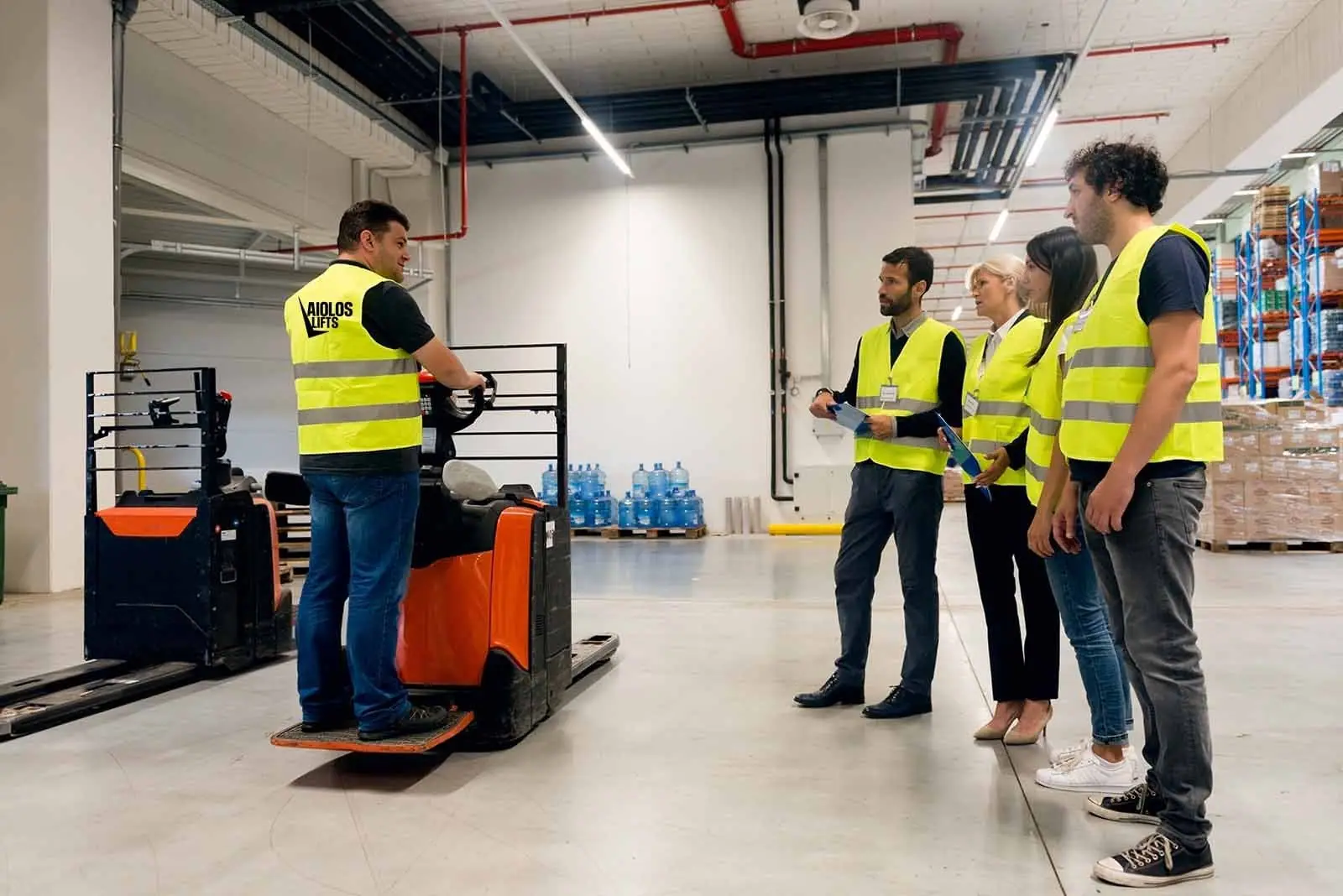
Operator training on an electric pallet truck in a warehouse

Guidelines for correct forklift use

4.9/5· 66 reviews

Interested in a quick quote?

Guidelines for correct forklift use from the experts at AIOLOS LIFTS

FORKLIFTS WITH INTERNAL COMBUSTION ENGINES

  1. Once we have checked the condition of the machine (oil, antifreeze, tyres, leaks, fuel), we take the driving seat and fasten the seat belt.
  2. We start the forklift's engine (a diesel engine may need preheating) and, if it is an internal combustion engine, let it warm up for a little while.
  3. We drive carefully until the engine reaches its normal operating temperature.
  4. We make sure we have good visibility wherever we drive.
  5. We avoid abrupt gear changes (on manual gearboxes) and press the clutch fully down when changing gear. On automatic gearboxes we take care when changing direction from forward to reverse and vice versa. (The machine must be brought to a standstill before the lever is moved.) Changing gear and direction correctly contributes greatly to the long life of the gearbox.
  6. When the steering wheel has been turned fully to the right or left and reaches its stop, we do not keep forcing it, as this puts extra strain on the pump.
  7. We make sure that any load we lift with the machine is within the limits set by the manufacturer.
  8. When we have finished work, we let the engine idle for a little while.
  9. We lower the forks so that they rest on the ground, to prevent accidents, e.g. someone tripping over them.

FORKLIFTS WITH ELECTRIC MOTORS

  1. On electric forklifts we make sure the electric motors are not exposed to very humid or dusty conditions.
  2. We take care when charging the battery • we put the battery on charge when its charge level is low and do not interrupt charging until it is fully charged • if the machine is not used heavily, we charge the battery at least once a week, and if we close for holidays we make sure the machines are fully charged • We do not charge our machines near open flames or sparks, as there is a risk of ignition • We do not let the battery run completely flat
  3. We check the battery electrolyte level at least once a week. • We top up only with distilled water and only as much as needed, never more • Topping up with distilled (deionised) water is always done after charging
  4. If the cells overflow, have them cleaned immediately or call a technician. If the battery overheats during charging, stop charging and call a technician.

AERIAL WORK PLATFORMS – LIFTING EQUIPMENT

  1. First we check the condition of the engine (oil, fuel, antifreeze – if it is an internal combustion engine), as well as the hydraulic systems, the wheels and the steering system, and then we start it.
  2. With electrically powered machines, we make sure they are not used in very humid or dusty areas.
  3. We never hose down motors or electrical parts.
  4. On electric lifting equipment we make sure the electric motors are not exposed to very humid or dusty conditions.
  5. We take care when charging the battery • we put the battery on charge when its charge level is low and do not interrupt charging until it is fully charged • if the machine is not used heavily, we charge the battery at least once a week, and if we close for holidays we make sure the machines are fully charged • We do not charge our machines near open flames or sparks, as there is a risk of ignition • We do not let the battery run completely flat
  6. We check the battery electrolyte level at least once a week. • We top up only with distilled water and only as much as needed, never more • Topping up with distilled (deionised) water is always done after charging
  7. If the cells overflow, have them cleaned immediately or call a technician
  8. If the battery overheats during charging, stop charging and call a technician.
  9. We make sure never to exceed the rated load set by the manufacturer.

About these operating guidelines

It would also be wrong to forget the guidelines for furniture hoists. You will find them below:

1. We position the hoist so that its outriggers can be levelled easily. 2. If the hoist has an external motor, we first check its condition (oil, fuel, antifreeze, wire ropes), then start it and let it warm up for a little while. 3. We set up the machine paying close attention to the safety measures, which include chocks under the outriggers and wheels, as well as keeping a safe distance from high-voltage cables. 4. While extending and retracting the ladder sections, we keep the boom as steep as possible, at more than 80°. 5. We tie the machine in at the top, to the balcony. 6. We test the platform without a load to make sure it behaves correctly and does not catch on anything. 7. We start work, taking care not to exceed the rated load set by the manufacturer. 8. Once we have finished and are folding the machine away, we let the engine run for a little while (at idle) so that its temperature drops.

Latest news